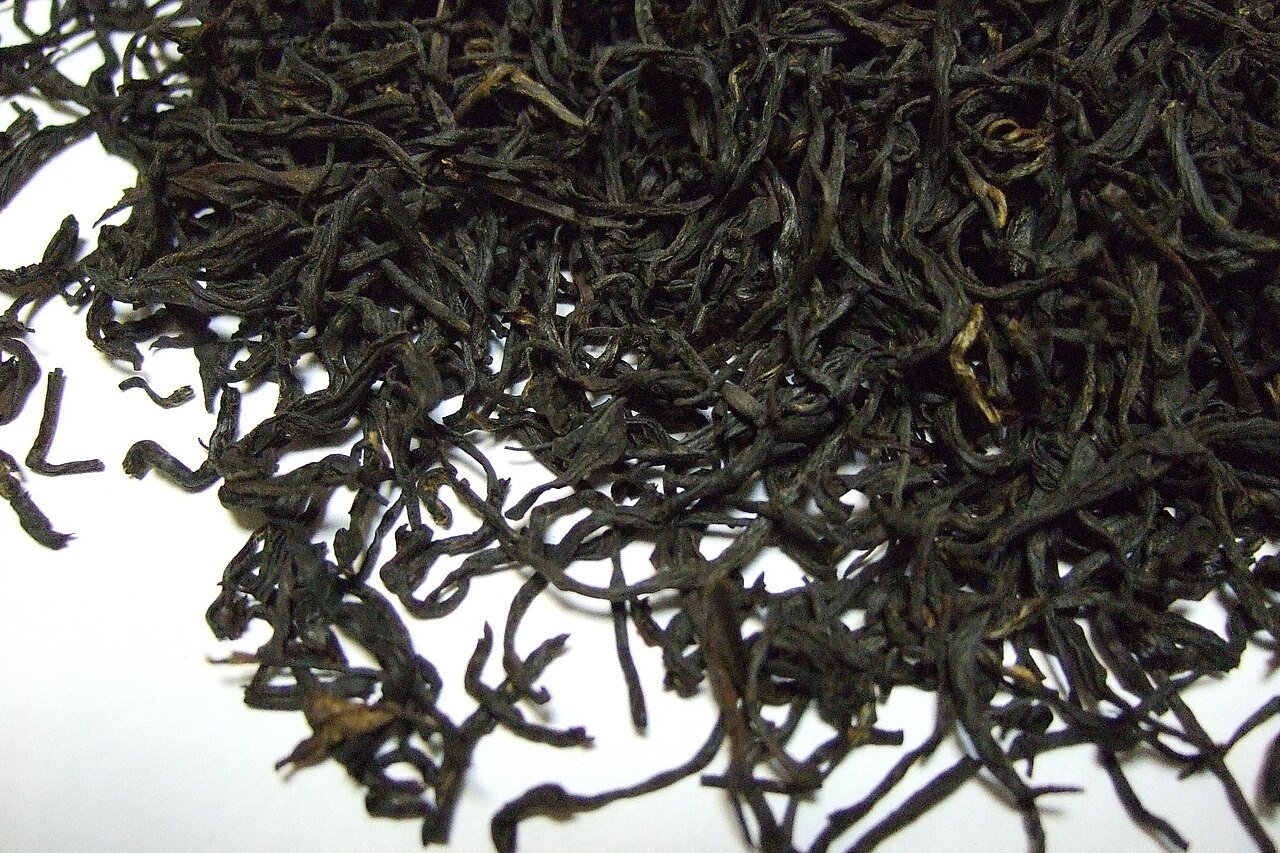
First mug: try 3 g in 200 ml around 90–95°C, taste after two minutes, and decant when balanced; follow a specific packet first.
Put Qimen, Keemun, red tea and black tea on one map
Qimen is a county in southern Anhui province and the source of the English spelling Keemun. Qimen hongcha identifies a tea in China's red-tea family. English speakers generally call that family black tea, looking at the dark dry leaf rather than the copper-red liquor. A packet saying Keemun black tea and a Chinese account saying Qimen red tea can therefore refer to the same broad kind of tea. The place name is worth checking at lot level, rather than assuming every blend mentioning Keemun is a single-origin Qimen tea.
Heicha, translated dark tea, follows different post-processing traditions. The shared English word black is a translation problem, not a reason to classify Keemun as heicha. A fully oxidized Keemun belongs with hongcha. Liu Bao and pu-erh are examples of dark-tea traditions to compare elsewhere. If a label simply says Chinese black tea, ask whether Keemun is its named origin or just one ingredient in a blend. That small distinction is more useful to a buyer than arguing over the color of a dry leaf.
Follow the leaf through withering, rolling and oxidation
A typical Keemun making sequence begins with withering, continues through rolling and controlled oxidation, and ends with drying. Withering makes the leaf more pliable; rolling changes its structure; oxidation develops the red-tea character before drying stabilizes it. Makers vary their leaf selection and finishing. This outline tells you why Keemun sits in hongcha without pretending every producer has one identical recipe. The exact leaf and handling still need to be described for a particular lot.
Tasting language can range from floral and fruit-like to cocoa or a gently smoky impression, depending on the sample and the person describing it. A word such as smoky is a sensory description, not evidence that the leaf was smoke-dried. Do not assume a smoke treatment without a producer saying so. Similarly, a dark, twisted dry leaf cannot prove Qimen origin. Read process notes and provenance separately; then make a cup and decide whether those suggested descriptors match your experience.
Read Mao Feng, Hao Ya and Gongfu cautiously
Keemun Mao Feng appears on identifiable whole-leaf products from Qimen. Twinings describes its Mao Feng as a finely twisted loose leaf and supplies Qimen County as origin. Hao Ya is another name seen on specialist Keemun listings. Such style or grade words can guide which packet you investigate, but sellers may apply them differently. Ask what the actual leaf selection, cut and producer are, instead of treating the extra phrase as a universal quality ladder.
Gongfu can be especially confusing on a packet. A seller may use it as part of a Keemun product name, while a brewing guide may use it for repeated small-vessel infusions. The word alone does not tell you how the leaf was made or how you must brew it. Look for a producer explanation and leaf photograph. A whole-leaf packet and a broken-leaf breakfast blend may both contain Keemun, yet their leaf form and intended cup can be quite different.
Separate a named tea from a breakfast blend
Some English Breakfast blends use Keemun alongside other black teas. Their ingredient statement says something about the blend, not that every leaf in the tin was grown in Qimen. A single-origin Keemun claim asks a different question: where did this lot's fresh leaf grow and who made it? Neither format is automatically preferable. A blend may be designed for a consistent robust mug; a named loose leaf lets you attend to one source's character.
For a meaningful comparison, read both labels before brewing. Note whether each names Qimen, identifies other ingredients, states whole or broken leaf, and gives a harvest or packing date. Some information may not be supplied. Keep that gap visible rather than filling it with an assumption. If you enjoy milk in a breakfast blend, try its first sip plain as well so you know what the leaf itself contributes; then prepare it however you actually like to drink it.
Make a measured first mug
As a starting trial for a named loose-leaf Keemun, weigh 3 g into a removable infuser and add 200 ml of pleasant drinking water around 90–95°C. Taste after two minutes and lift the infuser when the cup has enough body. Use the identified packet's directions where available; one Mao Feng seller suggests a two-to-three-minute loose-leaf infusion. A broken blend can extract faster than intact leaves, so check it early rather than applying the same time automatically.
If a cup becomes astringent, shorten the next steep before changing everything else. If it is thin, allow a little longer or increase leaf slightly on a later trial. Pour the entire infusion away from the leaves when it is ready. A second infusion can be tried if the leaf still gives a pleasant result, but the number of useful rounds depends on the actual tea and dose. Keep a short note of the water, weight and time so a good cup can be repeated.
Use short pours to examine one loose-leaf lot
A small vessel can show changes across pours. Try about 4 g of whole-leaf Keemun in 100 ml of water near 90°C, pour after roughly 20–30 seconds, and taste before setting the next interval. Decant completely each time. This is an exploratory recipe rather than a rule that every Keemun tolerates the same concentration. If the cup becomes too dense, shorten the pour or reduce the dose. Broken leaf may need a gentler starting point than an intact Mao Feng.
Do this with one named lot first, then return to the simple mug so you understand what the change in method accomplished. The small vessel may make early aroma easier to notice, while the mug shows how the tea works as a daily drink. Neither method establishes a grade or proves a geographic claim. The comparison is about the tea you bought, not a contest between brewing styles.
Compare clear labels and keep the tea protected
Choose two small, clearly described examples: perhaps a Qimen whole-leaf Keemun and a blend whose ingredient list names Keemun. Brew by weight with the same water, while respecting any specific maker directions. Record body, aroma, finish and how each cup changes as it cools. Do not announce a universal winner; the two products answer different needs. If a named style interests you, the producer's origin and process details help you find a comparable lot later.
Keep the leaves in their well-closed packaging or a clean, dry tin, away from heat, light, damp and strong odors. Retain the label and any harvest or packing information. A dark tea leaf is not immune to poor storage, and an old printed year is not proof of an improved cup. When revisiting a sample, compare it with your original brewing note before deciding it has changed. A small labelled packet and a repeatable recipe give you more useful information than a large anonymous reserve.
