In Chinese usage, hongcha means red tea and is what English-language shops usually call black tea. Heicha means dark tea and is a different family. Jasmine scenting is a further treatment of a tea base, not a seventh processing family.
The six families at a glance
This table names the defining processing choice and one example to investigate, not a promised flavour or a ranking. The same family can contain very different leaf grades and finishes. Use the linked family guides below when a packet gives a more specific style name.
| Family | Main processing clue | Named example |
|---|---|---|
| Green | Heat early to limit oxidation | Longjing or Bi Luo Chun |
| White | Manage withering, then dry | White Peony |
| Yellow | Add a controlled yellowing stage | Meng Ding Huang Ya |
| Oolong | Manage partial oxidation, then fix and finish | Tieguanyin |
| Black (hongcha) | Develop extensive enzyme-driven oxidation | Qimen or Keemun |
| Dark (heicha) | Use microbial post-processing | Liu Bao |
Pu-erh terminology, especially young raw pu-erh, needs its own explanation; see the pu-erh guide.
- GreenHeat early; limit oxidation
- WhiteWither, then dry
- OolongGuide partial oxidation
- BlackDevelop extensive oxidation
- YellowAdd a covered yellowing stage
- Dark teaMicrobial post-fermentation
This is a guide to processing, not a colour or strength scale. Raw and ripened Pu-erh take different routes; see the Pu-erh guide for that distinction.
Longjing green tea
White-tea buds
Tieguanyin
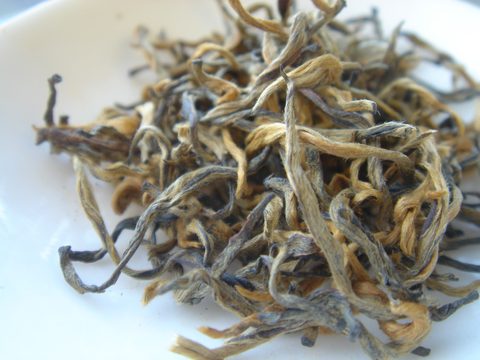
Dianhong black tea
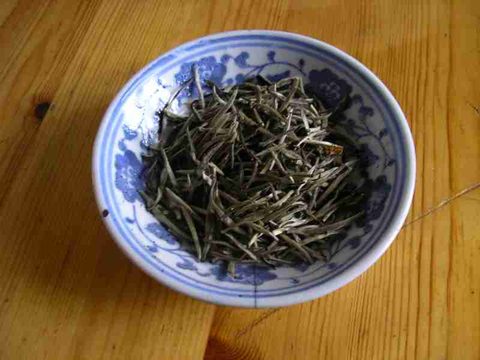
Junshan Yinzhen
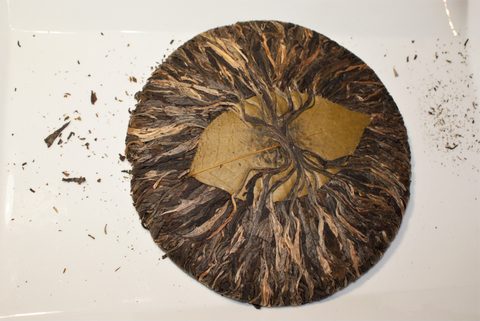
Raw Pu-erh cake
Read the process before the colour
All six families begin with leaves of Camellia sinensis. Processing gives them different characters: heat may halt much of the leaf's enzyme-driven oxidation, withering may allow some change, makers may deliberately bruise leaves, or finished material may undergo later microbial transformation. The colour of a dry leaf alone is a poor classifier. Roasting can make an oolong dark; a young raw pu-erh may look comparatively green.
Tea sellers and writers sometimes use 'fermented' for the oxidation of oolong or black tea. It helps to ask which process they mean. The controlled oxidation of black tea is different from the microbial post-processing associated with many dark teas. Names and boundaries also vary in the pu-erh trade, so a processing description is more informative than a single percentage of oxidation.
Green tea: heat fixes the leaf early
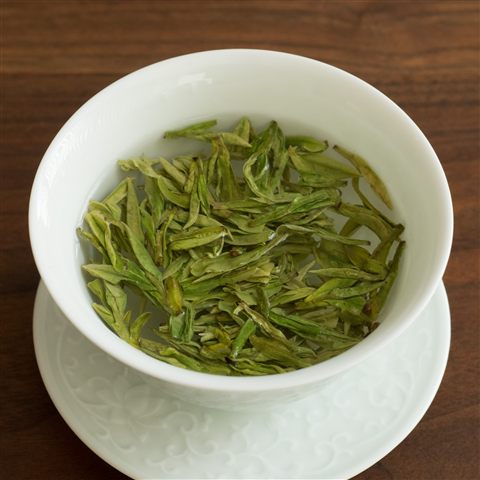
Green tea is heated relatively early to limit enzyme-driven oxidation, then shaped and dried according to the particular style. Chinese examples include pan-fired Longjing and Bi Luo Chun. A fresh green tea may taste grassy, nutty, marine, sweet or gently toasted; none of those notes is guaranteed by the family name. Leaf tenderness and finishing method matter as much as the category.
If you are trying green tea for the first time, buy a small amount with a named style and a clear brewing suggestion. Tender leaves can turn harsh when treated like a roasted oolong. In a 200 ml cup, start around 3 g and 80–85°C, taste after roughly one minute, then adjust. Read the dedicated green tea guide for differences within the family.
White and yellow tea: similar-looking leaves, different work
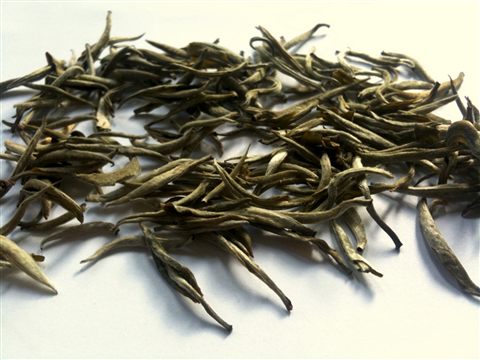
White tea is generally withered and dried without the early heat-fixing and rolling associated with most green teas. Silver Needle uses buds; White Peony commonly includes buds and leaves. White tea is not simply an untouched leaf: the pace of withering and drying shapes its aroma and texture. Expect variation from light, fresh cups to fuller examples made from larger leaves or stored longer. Explore the white tea guide before assuming every white tea should be brewed cool.
Yellow tea begins with steps related to green tea, then receives a managed yellowing stage often called men huang. Makers may wrap or rest warm, moist leaves, and the exact sequence differs by tea. It is a production method, not green tea that has gone stale. Yellow teas can be soft and rounded, but taste depends on the actual leaf. The yellow tea guide explains what to look for when a listing offers only a colour name.
Oolong: controlled oxidation and many finishes
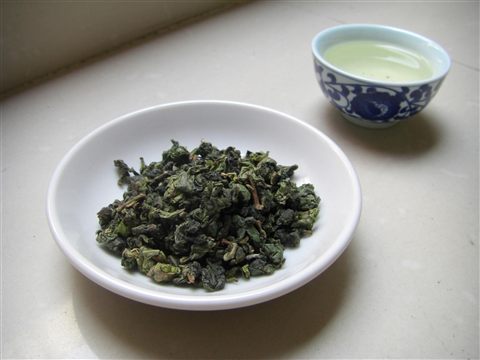
Oolong makers wither and handle the leaf to develop aroma and controlled oxidation before fixing, shaping and drying it. Some oolongs are tightly rolled and floral; others are long, twisted and roasted. Tieguanyin from Anxi and Wuyi rock teas are both Fujian oolongs, yet they do not taste or brew alike. Roast, leaf material and maker choices are more useful clues than the blanket phrase 'semi-oxidized'.
A lightly finished Tieguanyin might suggest flowers and a fresh edge; a Wuyi tea may present baked fruit, spice and roast. Neither description is a promise for every product. If a label says only 'oolong', ask for origin, style and roast before choosing a recipe. Our oolong introduction and Tieguanyin guide give more specific routes into this broad family.
Black tea and dark tea are separate families
Chinese hongcha, called black tea in English, is made with substantial enzyme-driven oxidation before drying. Fujian's unsmoked or smoked Lapsang Souchong and Yunnan's Dianhong illustrate how much diversity fits under that English name. The Chinese term refers to the reddish liquor, not a claim that all dry leaves look red. Use the black tea guide to compare style names and starting brewing temperatures.
Heicha, or dark tea, refers to teas shaped by microbial post-processing after earlier manufacturing steps. It includes traditions beyond pu-erh. Ripe pu-erh is deliberately pile-fermented; raw pu-erh is made differently and can change during storage. Classification of young raw pu-erh is discussed differently by specialists, so do not call all pu-erh fully oxidized or assume every cake is ripe. The pu-erh guide separates raw and ripe buying questions.
Where jasmine and other scented teas fit
Jasmine tea is often made by exposing an already made tea base to fresh jasmine flowers in repeated scenting stages. Green tea is a common base, but jasmine-scented white and black teas also exist. The scenting changes the finished tea's aroma; it does not erase the base tea's processing family. A jasmine pearl can therefore be a green tea, and its rolled pearl shape is another detail rather than a separate family.
When buying, ask what the base tea is and how the scent was added. A packet saying 'jasmine' alone does not tell you whether to use a tender-green-tea recipe or one suited to a black-tea base. The jasmine tea production article and jasmine pearls page show how this distinction becomes practical.
Decode the words on a tea label
A tea name may combine a place, a processing family, a cultivar and a leaf form. 'Anxi Tieguanyin oolong' points to an origin claim, a named tea or cultivar, and the oolong family. 'Qimen hongcha' points to a place and a red or black tea. Those parts tell you more than a broad shop category such as 'Chinese tea'. Check whether the maker states a roast, harvest or scenting treatment too.
Do not read an English colour word as a brewing strength scale. Hongcha is the family usually sold as black tea in English; heicha is dark tea. A Longjing label names a green tea style, while Bi Luo Chun is another named green style. White Peony identifies a leafier white-tea style, not a grade of green tea. Read the producer's actual description before assuming a style name guarantees one taste or origin.
You may also see claims about the 'Ten Famous Teas of China'. Different lists circulate, so that phrase is a prompt to examine a named tea, not a fixed official family classification. Start with the processing family and the specific product in your hand.
Do all six tea families contain caffeine?
Yes. These families are made from Camellia sinensis leaf, which contains caffeine. A pale white tea is not caffeine-free, and a dark-looking roast is not a dependable measure of the caffeine in your cup. Leaf material, particle size, dose, water and infusion conditions all affect the brewed amount. Studies of tea infusions show wide variation even among samples within a category.
If caffeine is a deciding factor, record how much leaf you use and how you brew it, and do not rely on a fixed green-to-black or light-to-dark ranking. The family is useful for understanding manufacture; it cannot provide a precise caffeine figure for an unidentified packet or a particular pour.
Choose a first comparison that teaches you something
Compare two named examples in the same family before drawing conclusions about a whole category: a lightly finished and a roasted oolong, for instance, or a bud-heavy and leafier white tea. Brew them in comparable vessels, follow each maker's note, and record leaf amount, water, time and the result. This reveals differences in the actual products without turning the six-family map into a rigid taste chart.
For a cross-family flight, try a green tea, a Fujian oolong and a black tea in small amounts. Separate each infusion from the leaves and taste before adding time. Keep the source and processing description with your notes. If you like a tea, the next useful question is usually about its particular origin and finish, rather than which family is supposedly best.
Sources and further reading
- TeaVivre, tea names and Chinese category terms
- TeaVivre, dark tea and pu-erh distinction
- TeaVivre, yellow tea processing
- TeaVivre, white tea processing
- TeaVivre, jasmine black tea base
- Astill et al., factors affecting caffeine in tea infusions
- Ayakdaş and Ağagündüz, caffeine in six tea-type infusions
- TeaVivre, Meng Ding Huang Ya yellowing process
- Tea Guardian, microbial post-fermentation in dark tea
- Seven Cups, varied lists of famous Chinese teas


