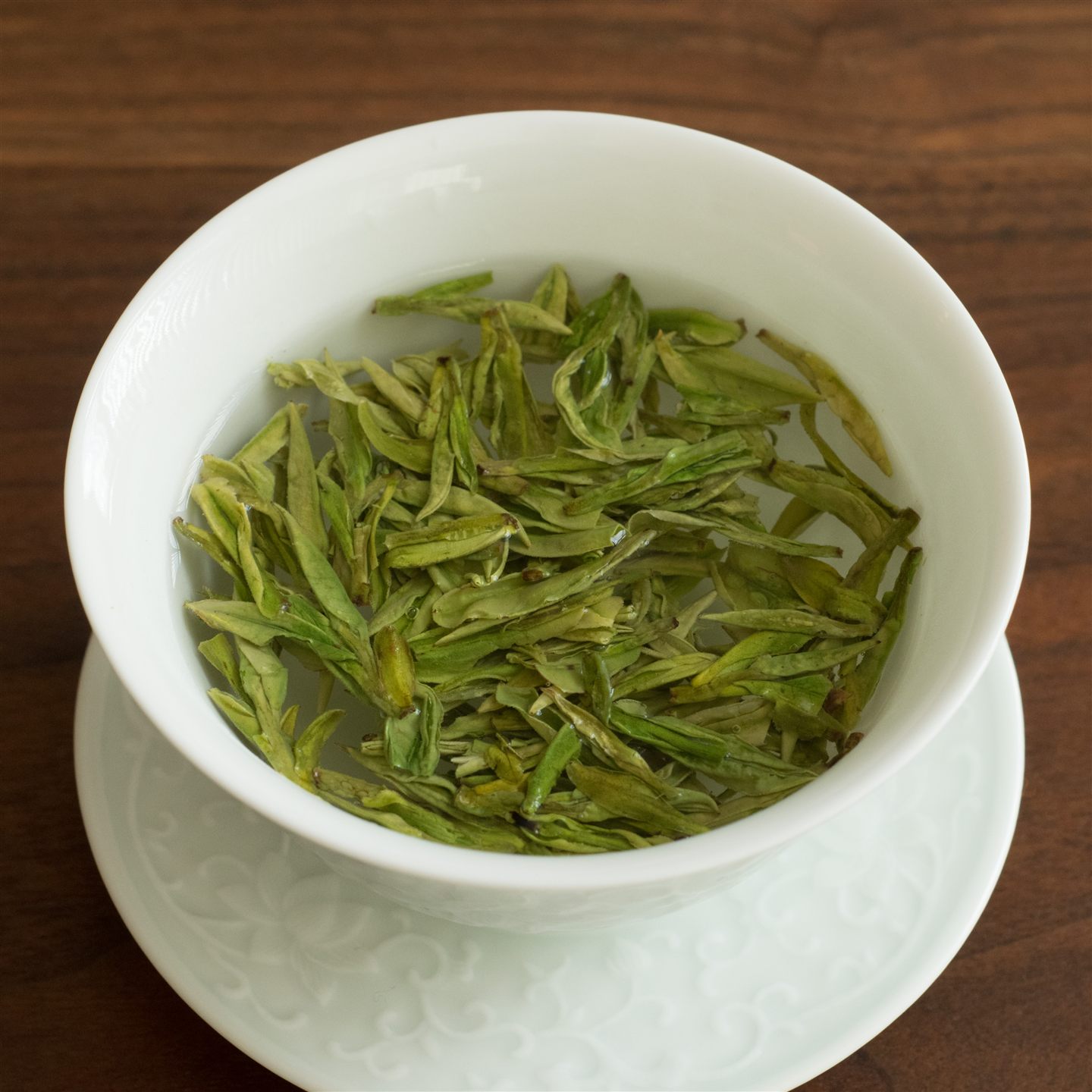
First mug: try 3 g of leaves in 200 ml of water around 80–85°C; taste after one minute and remove the infuser when the cup suits you.
What makes a tea green
All true tea comes from Camellia sinensis. For green tea, makers apply heat soon after picking to limit enzyme-driven oxidation. Chinese producers often use a hot pan, although steaming and other methods also exist. The leaf may then be rolled or pressed into shape and dried. These steps help explain why a green tea can be flat, twisted, needle-like, or tightly curled without changing its basic family.
The word green describes processing, not a guaranteed shade in the cup. A finished leaf may look olive, yellow-green, or dark green; the liquor can be pale gold rather than vivid green. Color alone cannot prove freshness or quality. A properly made tea should offer a clean aroma and a taste you enjoy, even when its appearance differs from a photograph.
Choose among named Chinese green teas
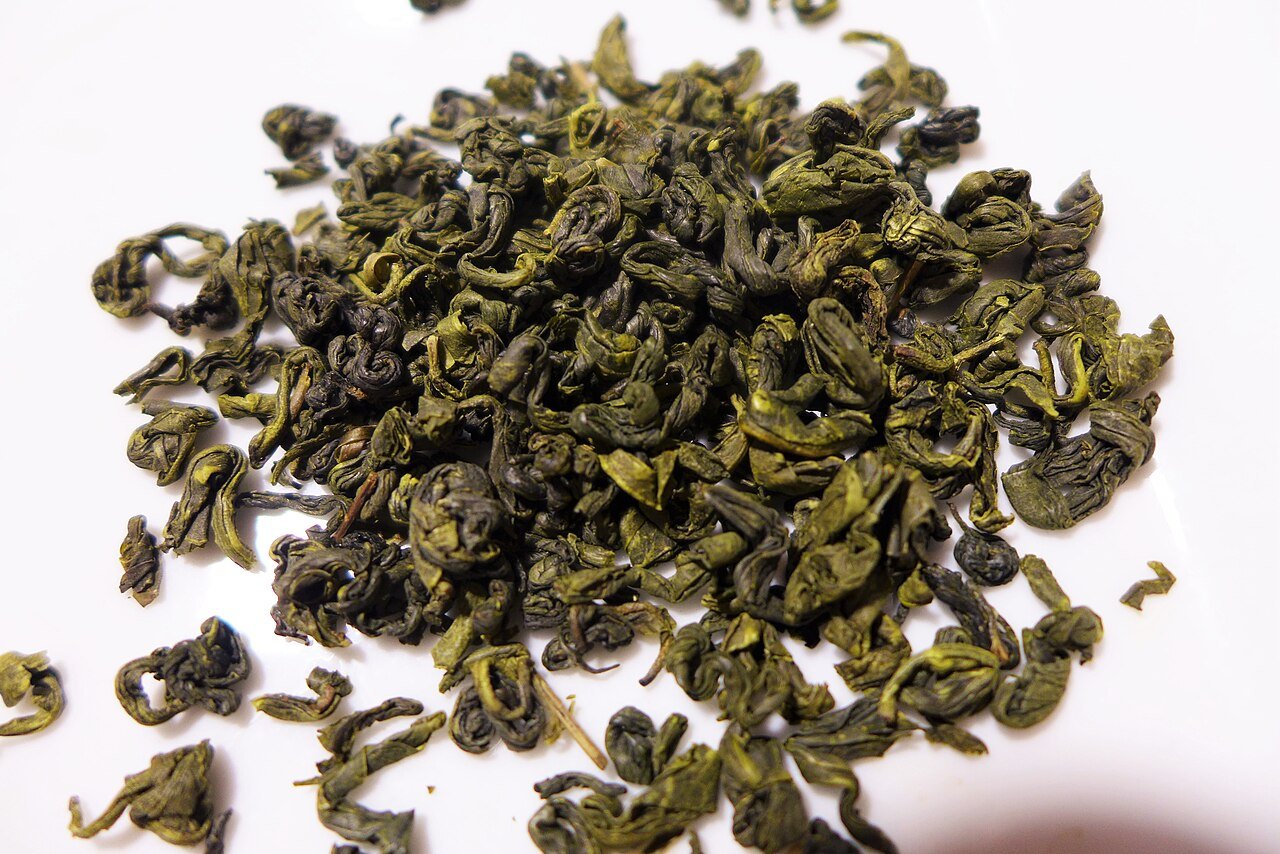
Longjing, or Dragon Well, is usually recognized by its flattened leaf, made through pan work. It offers an accessible way to notice how heat and shaping affect aroma. Bi Luo Chun is a slender, curled leaf; TeaVivre describes its fixation, rolling, shaping, and drying as distinct stages. Neither name describes one identical flavor across every maker and harvest.
The six examples below are a way to read a packet, not a ladder of quality. Their place names refer to established traditions; a broad style name on a modern packet may cover other growing areas. Ask the seller for the actual origin and making method. The shape is useful for recognizing a style, but it cannot prove origin or quality by itself.
Taste two side by side if you can buy small amounts. Make both with the same drinking water and modest leaf dose, then use each maker's temperature advice. Compare the dry leaf, aroma after wetting, first sip, and finish. A difference in weight between a flat and curled teaspoon is a reason to measure grams, rather than assuming equal spoonfuls give a fair comparison.
| Style | Traditional area | Leaf or making clue |
|---|---|---|
| Longjing (Dragon Well) | Hangzhou, Zhejiang | Flattened leaves shaped during pan work |
| Bi Luo Chun | Dongting area, Jiangsu | Fine, tightly curled leaves and buds |
| Huangshan Maofeng | Huangshan, Anhui | Long, slightly curved bud-and-leaf material |
| Xinyang Maojian | Xinyang, Henan | Slim, straight, needle-like leaves |
| Lu'an Gua Pian | Lu'an, Anhui | Leaf-focused picking without the bud; flat, loose leaf form |
| Taiping Houkui | Huangshan area, Anhui | Long, flattened bud with two leaves; hand pressing in traditional production |
These are style clues, not an authenticity test. Leaf size and finish vary by maker and grade.
Choose by useful details, not grand labels
Ask for the tea's name, growing area, harvest period if known, and packing date. A seller who can identify the specific leaf and explain its brewing advice gives you more to work with than a generic claim such as premium green. Early spring is meaningful for some named teas, but a claimed picking date cannot tell you whether that batch was made or stored well.
Choose a small packet for a first trial. If you enjoy light, fresh cups, compare two leaf shapes before chasing rarity. If you prefer a stronger or more roasted impression, look for a producer description that actually mentions the finishing style. A photograph helps you recognize the form; it cannot establish the aroma, origin, or value of tea you have not tasted.
Brew a calm first mug
Use a mug and removable infuser so you can stop the infusion. As a test, weigh 3 g of leaf for about 200 ml of safe, pleasant-tasting water at 80–85°C. Taste after roughly one minute. If it is still very light, allow a little longer; lift the infuser once the balance is right. Start with the packet's directions when they differ, especially for unusually tender or robust leaves.
Do not treat the starting temperature as an exact rule. A thick mug, a cold glass, and an open cup each change the heat around the leaves. If you lack a temperature kettle, a kitchen thermometer makes trials repeatable. A fixed wait after boiling is less reliable because kettle volume and room temperature vary. Make the first cup simple enough that you can remember what to change.
Adjust the taste one variable at a time
If the cup is sharp or bitter, shorten the contact time first; on the next attempt, try slightly cooler water if needed. If it is faint, allow a little more time or use a little more leaf. Avoid changing dose, heat, and time together. You will learn more from two controlled cups than from a complicated recipe whose effects you cannot separate.
The same leaves may make another pleasant infusion. Add fresh water and taste rather than promising a fixed number of rounds. A short first steep and a longer second one can reveal different parts of the tea. If the second cup is thin, the result may simply mean that this leaf, dose, and mug have given what they can.
Try an open glass when you want to watch the leaves
For a second method, put a modest measured dose of green tea in a heat-safe clear glass and add water at the packet's suggested temperature. Leave enough space to hold the glass safely; a hot, thin glass can be uncomfortable to grip. Let the leaves open and settle, then sip carefully without swallowing the leaves. There is no infuser to lift, so this method is less precise than the mug trial above.
When the glass is partly empty, top it up with fresh water and taste again. The leaves remain wet throughout, so extraction continues while you drink; a slow drinker may find the last sips stronger than the first. Use fewer leaves, cooler water, or a smaller refill on the next try if the cup becomes too assertive. This is a useful way to observe a long or curled leaf unfurl, but it is a choice rather than a rule for every Chinese green tea.
Protect the character you bought
Green tea is commonly bought for its current freshness, so protect it from heat, light, moisture, air, and strong smells. Keep a small working supply in its opaque, well-closed pouch or a clean, dry tin, away from the stove. Close it promptly after measuring. Large reserves can be portioned into separate sealed packs to reduce repeated exposure.
Cold storage can help when the pack is thoroughly sealed, but a refrigerator also contains moisture and food odors. Let a chilled, still-sealed packet return to room temperature before opening it. For a modest amount you will drink soon, a cool dry cupboard may be easier. Follow the producer's storage note where available rather than assuming every green tea has one shelf life.
Keep the family boundary clear
A jasmine-scented green tea remains a green tea base with an added scenting step. An oolong that looks green is still an oolong because its processing takes a different path. Yellow tea can resemble green tea in the finished leaf, but controlled yellowing after heat fixing distinguishes its method. Those labels are useful when selecting temperature and setting expectations; they are not a ranking of what you ought to like.
There is no need to buy special equipment before you can notice these differences. A scale, an infuser, and a notebook are enough to compare two leaves fairly. Record the tea, water, dose, and first steep. If you want to explore short repeated pours later, the brewing guides can take you there after you know the everyday cup you enjoy.
Chinese greens are often pan-fired, but steamed Chinese examples exist; Japanese green teas are often steamed. Those are common methods rather than borders that define a separate tea family. Ask how this particular leaf was fixed if that distinction matters to your comparison.
Green tea contains caffeine. The brewed amount changes with the leaf and the dose, heat, and time used, so its family name cannot give you a dependable per-cup number. See the shared caffeine note for the wider comparison. A named origin or early picking claim can guide a trial, but the result depends on the leaf and how you use it at home.
Sources and further reading
- TeaVivre, how green tea is processed
- TeaVivre, Bi Luo Chun processing
- TeaVivre, storing green tea
- TeaVivre, green-tea leaf shapes
- TeaVivre, traditional growing areas of named green teas
- TeaVivre, Taiping Houkui hand making
- TeaVivre, green-tea fixing methods and Chinese steamed example
- In Pursuit of Tea, open-glass Chinese green-tea brewing
- Experimental study, caffeine in tea infusions under different brewing conditions

